
How to Hit 10,000 Steps a Day While Working From Home (From a Parent Who's Actually Trying)
Why 10,000 steps matters (and why it’s harder than ever for WFH folks)
The science quickly
The 10,000 steps goal was originally a Japanese marketing slogan from the 1960s, but research has since caught up. Most studies now show that hitting somewhere between 7,000 and 10,000 steps a day significantly reduces your risk of heart disease, improves mood, helps maintain weight, and reduces overall mortality.
10,000 isn’t magic. It’s just a solid, memorable target that lands most people in the healthy range.
Why WFH makes it brutal
When you worked in an office, you probably had no idea how many steps you got just from existing:
- Walking to the car
- Walking into the office
- Walking to the bathroom (the far one)
- Walking to meetings
- Walking to the break room
- Walking to grab lunch
- Walking back to your car at the end of the day
That “free movement” probably added up to 4,000-6,000 steps a day without you even trying.
WFH eliminates almost all of that. Your commute is six feet. Your bathroom is fifteen feet away. Your lunch is in the kitchen, which is thirty feet away. You can go an entire workday and rack up fewer steps than your old parking lot walk used to give you.
The hard truth: if you work from home, you have to intentionally build back the movement you used to get passively. Nobody does it for you.
The realistic 10,000 step plan for parents
Here’s how I think about the math. You don’t need to do all of this every day — pick the combos that fit your life and rotate them.
Morning (1,500-2,500 steps)
If you have kids, your morning is already chaotic movement. Getting kids dressed, making breakfast, packing bags, school drop-off — this is all steps you’re already taking.
Tips to max this:
- Park farther from school if you drive
- Walk to drop-off if you’re close enough (game-changer if feasible)
- Walk around while brushing your teeth or making coffee
- Do one lap around the house before sitting down at your desk
Realistic total: ~2,000 steps before you ever sit down to work.
Workday (3,000-5,000 steps)
This is where most WFH parents fail. The workday is 8 hours of essentially zero movement if you’re not intentional about it.
The solutions:
1. Use a walking pad under your desk
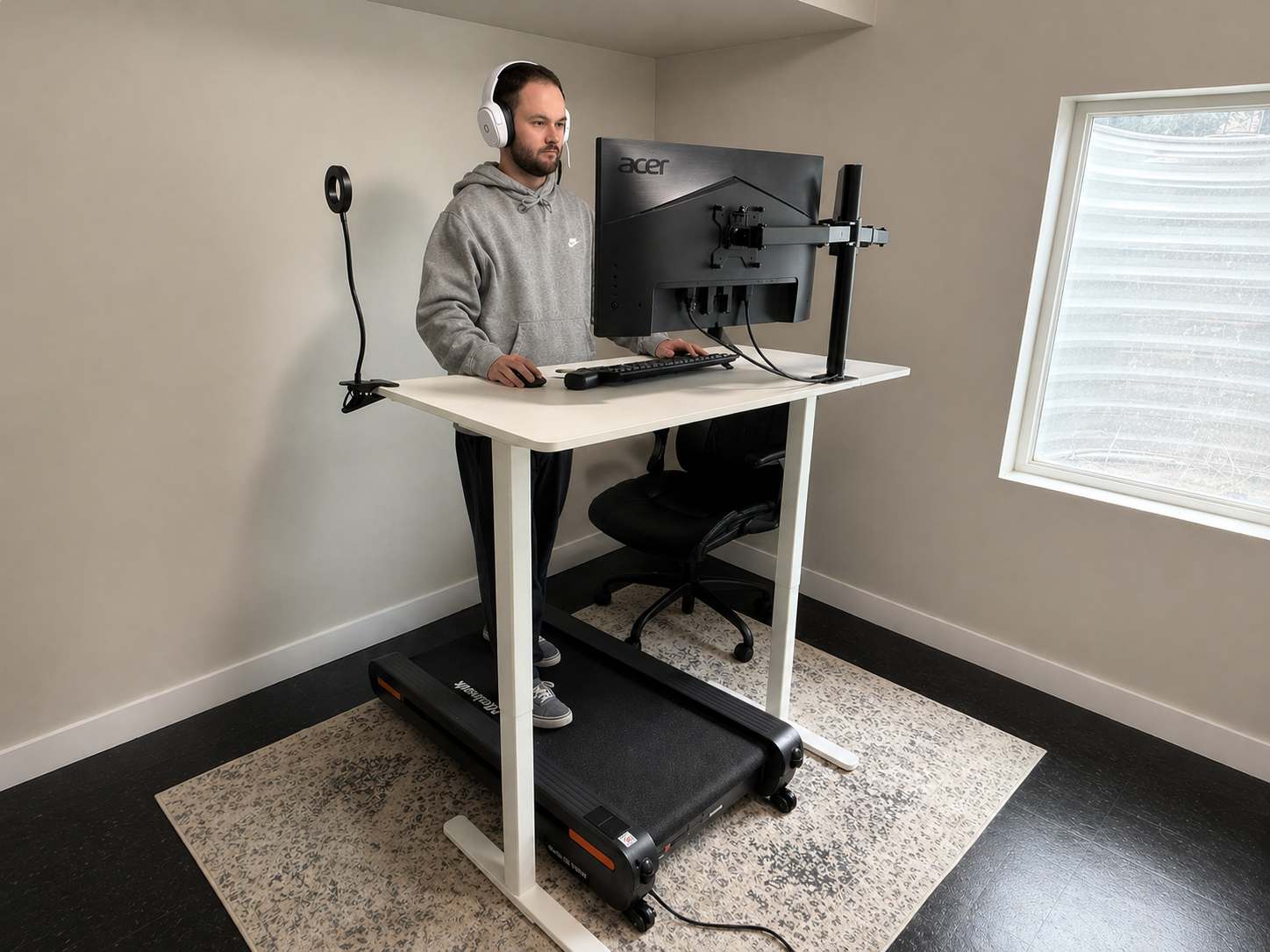
This is the single biggest move I’ve made. A walking pad lets you walk slowly (1.5-2.5 mph) while doing the parts of your job that don’t require intense focus — answering Slack messages, sitting through non-camera Zoom calls, reading emails, reviewing documents.
One 30-minute walking pad session at 2 mph = roughly 3,000 steps. Do two 30-minute sessions and you’ve hit your daily goal just from work.
I personally use the Vitalwalk Apollo 11 Ultra — you can read my full honest review here if you’re considering one. The short version: it’s sturdy enough to actually last, quiet enough that it doesn’t ruin Zoom calls, and the deck is wide enough to walk normally on. Not the cheapest option on Amazon, but one of the few I’d actually trust to hold up to daily use.
2. Walk during phone calls
Any meeting that doesn’t require you to look at a screen = walking opportunity. Camera off, headphones on, walk.
On a walking pad: easy. Around the house: also easy. Pacing is fine — nobody can see you.
Estimate: One 20-minute call = 1,500-2,000 steps.
3. Movement snacks every hour
Set a timer. Every hour, stand up and do 100-200 steps. Go grab water. Walk to the mailbox. Do a lap around the house.
Seems small. It isn’t. 8 hourly breaks × 150 steps = 1,200 steps you didn’t have before, with zero effort.
4. Take kids’ breaks WITH the kids
If you have young kids and you’re interrupted constantly anyway, use those interruptions. When they need a snack, walk them to the kitchen. When they want attention, do a silly dance-around-the-living-room thing. When they’re playing, walk in circles near them.
Two birds, one stone — steps + the kid time they need.
Afternoon + Evening (2,000-3,000 steps)
This is where the easy wins are, if you can build these into your routine.
The post-meal walk trick
This is the one I push hardest because it’s the biggest ROI.
After every meal, take a 10-minute walk. Just 10 minutes. Inside, outside, on the walking pad — doesn’t matter.
Math: 10 minutes × 3 meals = 30 minutes of walking = ~3,000-4,000 steps.
Bonus: walking after meals is one of the few research-backed habits for improving blood sugar, digestion, and energy. You get fitness + health benefits at the same time.
School pickup / errands / kid activities
If you have to do a pickup, park at the end of the lot. Walk the long way. Add 500-1,000 steps without adding any real time.
Kid has a sports practice? Don’t sit in your car for 45 minutes — walk around the field or parking lot. That’s 2,000-3,000 steps right there.
The after-kids-are-asleep walk
If your evening allows, a 15-20 minute walk after bedtime is magical. Quiet, peaceful, actually enjoyable — and another 2,000 steps banked.
Things I’ve stopped doing (because they don’t work)
Being honest: these things sound good but haven’t actually helped me consistently hit 10,000 steps.
“I’ll go to the gym after work”
No. Some days, yes. Most days, no. Life happens. Kids get sick. Work runs late. Dinner goes sideways. You cannot rely on one big workout to save a sedentary day.
Better: build movement INTO your day, not ON TOP OF your day.
Aggressive morning workouts
A hard 45-minute workout at 6 AM gets you maybe 4,000 steps and leaves you wrecked. Then you sit for 10 hours. Then you crash.
Better: smaller amounts of movement distributed across the day beat one big workout for step count AND sustainability.
Step-goal shame
If I hit 6,000 one day, I used to feel like I failed. Then I’d skip tracking for a week.
Better: 6,000 is better than 2,500. Progress > perfection. Track consistently, aim for better, don’t punish yourself for bad days.
What NOT to buy (because this matters)
Since this post is about helping you actually succeed, let me save you some money:
 Don’t buy a cheap walking pad
The $150-200 walking pads on Amazon are cheap for a reason. Thin decks, weak motors, wobbly frames. They break in a month or two, and then you’re frustrated and back to sitting. Spend a bit more on something built to actually last.
I break this down in detail in my Vitalwalk review.
Don’t buy an elaborate standing desk right away
You can test the whole “move more at work” concept for free by just standing up more. Don’t drop $800 on a motorized desk until you know you’ll actually use it.
Don’t buy a fitness tracker you’ll never look at
Your phone already counts steps. Use it first. If you love tracking and want more data, THEN consider a watch.
The actual plan (summary)
If I had to give one realistic plan to a parent working from home:
- Morning: Move during your routine — park far, take stairs, pace while you drink coffee. (~2,000 steps)
- Workday: One 30-minute walking pad session during emails or Slack. Hourly movement snacks. Camera-off calls = walking. (~4,000 steps)
- Midday: 10-minute post-lunch walk. Do it. (~1,000 steps)
- Afternoon: Work in another walking pad session if you can. Any errands, park at the back. (~2,000 steps)
- Evening: A short walk after dinner or after kids are asleep. (~1,500 steps)
Total: ~10,500 steps. Without a heroic workout. Without gym time. Without sacrificing family life.
Start small
If you’re currently at 2,500 steps a day, jumping to 10,000 tomorrow isn’t realistic. Aim for 5,000 first. Hit that for a week. Then aim for 7,000. Then 10,000.
Building up gradually means you actually stick with it. Crashing into the 10K goal and failing means you quit.
The parents (and desk workers) I see crushing their step goals aren’t the ones with the most discipline — they’re the ones who built the habits slowly and stopped trying to do it through willpower.
Start with the easiest win: one 30-minute walking pad session during Slack time. That alone will add 3,000 steps to your day. That might be the single biggest leverage point in this whole post.
The walking pad I use
If you’re going to invest in one piece of equipment to hit your step goal, a walking pad is it.
I personally use the Vitalwalk Apollo 11 Ultra — it’s been the single biggest change that’s helped me consistently get my steps in while working from home. Quiet enough for Zoom calls, built solid (3.0 HP brushless motor, 350 lb capacity), and the auto-incline lets me get a real workout in 20 minutes if I want to push harder.
 Read my full Vitalwalk review here — including what I’d warn other parents about and who shouldn’t buy it.